
Posted by B. Decker on 12th Aug 2026
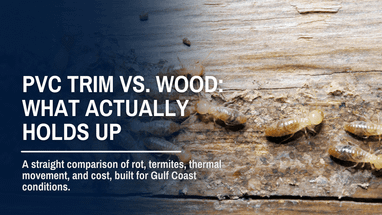
PVC Trim vs. Wood: Moisture, Termites & Cost Compared
Product Comparisons
By B. Decker • Updated August 2026 • 9 min read
Fast Answer: PVC trim is a plastic board used in place of wood on the outside of a home. It won't rot, and termites can't eat it for food. It costs more upfront than wood, moves more with heat, and can't be stained.
Farco Plastics Supply sells and cuts PVC trim, including LumaTek Trim, out of six branches: Clearwater, Ft. Lauderdale, Jacksonville, and Orlando, Florida; Memphis, Tennessee; and Montgomery, Alabama. That's aggressive-termite country, hurricane country, and some of the most humid air in the U.S. Most trim comparisons online are written for nowhere in particular. This one covers how PVC trim really holds up against wood, downsides included.
What Is Cellular PVC Trim?
Cellular PVC trim is PVC plastic foamed into a lightweight board, then cut into trim shapes for the outside of a building: corner boards, fascia, soffits, and window trim. It's covered under a building code standard called ICC-ES AC227, which approves it as exterior trim, not as a structural material.
That distinction matters. PVC trim replaces the wood trim on the outside of a house. It does not replace the framing lumber that holds the house up.
Does PVC Trim Rot?
No. Here's why, and it's worth understanding because it explains most of the rest of this guide. Water alone doesn't rot wood. Fungi do, and fungi need water to survive.
Wood starts to decay once it holds more than about 28 to 30 percent moisture for a sustained period (that's called the fiber saturation point, per the USDA Forest Products Laboratory). Normal dry lumber sits well under 20 percent, which is why untreated wood can still last for years before it fails. Once rot fungi get going, they can keep eating the wood even at lower moisture, as long as it stays reasonably warm.
PVC trim has no wood fiber in it. Rot fungi have nothing to eat, no matter how wet the board gets. That's a better explanation than "PVC doesn't absorb water," which isn't quite true. It absorbs a small, measurable amount (tested under ASTM D570). The exact number varies by product.
Is PVC Trim Termite-Proof?
Not completely, and most trim guides get this wrong. Testing shows PVC trim resists termites about as well as pressure-treated wood. That's a tie with treated lumber, not immunity.
Termites can't eat PVC. It gives them nothing to digest, so they can't build a colony on it. But Formosan termites, an aggressive species common across Farco's Southeast markets, are known to chew through plastic and other non-food materials just to reach wood on the other side (documented by NC State Extension and the Texas Invasive Species Institute). A 2013 lab study on plastic cable sheathing backs this up: Formosan termites caused moderate damage, while the more common eastern subterranean termite caused none.
The honest version: PVC trim removes the food source. It doesn't build a wall. In Formosan territory, an aggressive colony can still tunnel through it to reach wood behind it. Treat PVC trim as one part of a pest strategy, not the whole plan, especially near the Gulf Coast.
Thermal Expansion: The Real Installation Risk
Wood and PVC move in opposite ways, and this is the single biggest reason PVC trim jobs go wrong. Wood swells and shrinks side to side when humidity changes, but barely moves along its length. PVC does the opposite: it stays put side to side but grows and shrinks lengthwise as the temperature changes.
Here's what that looks like in real numbers. PVC trim expands about 3.2 × 10⁻⁵ inches per inch for every degree Fahrenheit it warms up (tested per ASTM D696). On an 18-foot board going from 50°F to 100°F, a hot summer day, that works out to:
About ⅓ of an inch of growth over the length of the board
That's enough movement to pop a joint open if you don't plan for it. The fix: leave a gap of about ⅛ inch for every 18 feet of board (a bit less if it's already hot when you install it), and glue joints with PVC cement instead of caulk. The cement sets up fast, roughly 10 minutes of working time, with a full cure in 24 hours.
Heat Deflection and the Dark-Color Rule
PVC trim starts to soften around 145 to 150°F (tested per ASTM D648). That's not far above what a dark-painted board can reach sitting in direct sun.
That's why manufacturers restrict dark paint colors on PVC trim. Anything darker than a Light Reflectance Value of 55 needs a special vinyl-safe paint, because dark colors absorb more heat and can push the board past its softening point. This isn't a cosmetic rule. On a west-facing wall in Orlando in August, a dark board can genuinely warp. Stick to lighter colors, especially on south- and west-facing walls.
Fire Performance, Corrected
PVC trim passes a strict flame-spread test (ASTM E84) and earns a Class A rating, the top tier, same as many approved building materials.
Class A doesn't mean fireproof, and it doesn't mean the material can't burn. PVC trim is still a combustible material, and building codes limit where and how much of it you can use, especially close to the ground and close to neighboring buildings. If you see a claim that PVC trim "doesn't support combustion," that's wrong. Don't repeat it.
PVC Trim vs. Wood: Side-by-Side Comparison
| Property | Cellular PVC Trim | Wood Trim |
|---|---|---|
| Rot resistance | No cellulose, no food source for decay fungi | Decays above 28–30% moisture content without treatment |
| Termite resistance | Parity with treated lumber per ESR-1074; not immune to Formosan tunneling | Vulnerable unless pressure-treated |
| Movement mechanism | Along length, driven by temperature | Across grain, driven by humidity |
| Heat sensitivity | HDT ~145–150°F; dark colors restricted (LRV 55+) | No comparable heat restriction |
| Fire classification | Class A flame spread; combustible, code-limited placement | Combustible; treatment can improve flame spread class |
| Finish | Cannot be stained; light-color paint only | Stainable or paintable, any color |
| Structural use | Nonload-bearing trim only, per AC227 | Can be structural, depending on grade and species |
| Upfront cost | Higher material cost | Lower material cost, higher lifecycle maintenance |
Cost Over Time
Installed exterior trim, any material, runs about $6.29 to $11.10 per linear foot as of May 2026 (Homewyse). If you see older figures quoting $1.40 to $1.75 per foot for PVC, that's 2015 pricing. Don't use it.
The sticker price isn't the full story. Look at total cost over time instead: material, plus paint labor, plus repainting every five to seven years, plus any rot repair, versus PVC's material cost with no repainting needed. Contact your local Farco branch for current LumaTek Trim pricing by profile, plus a comparable pine or cedar quote, and run the numbers for your own project.
Where Wood Still Wins
Cellular PVC is not the right material for every job. A few situations still favor wood:
- Stain-grade appearance. PVC cannot be stained. If the design calls for exposed natural wood grain, PVC is the wrong material.
- Structural applications. PVC trim is nonload-bearing under AC227, full stop. Wood can carry load.
- Historic and restoration work. Profile authenticity and review-board approval often require wood.
- Very long unbroken runs. Wood moves less along its length, which makes it more forgiving of sloppy joint detailing on long spans.
- High-heat exposure. Dark colors, west elevations, and reflective-glass adjacency are real constraints for PVC that wood does not share.
- Upfront budget. PVC costs meaningfully more per foot. On a short-hold property, that math may not close.
- Environmental profile. Wood is renewable and sequesters carbon. PVC is a petrochemical product with limited recycling infrastructure. That is a real trade-off, not a reason to avoid the conversation.
Regional Considerations
Farco's branches sit in Florida, Tennessee, and Alabama, right in Formosan termite range, with humidity above 70 percent for much of the year and hurricane-force wind exposure. That's a tough environment for exterior trim. PVC's resistance to rot and humidity is a real advantage here. But you still need to plan for thermal movement and avoid dark colors, or an Orlando or Memphis summer will find every installation shortcut.
Fastening and Installation
Use stainless steel or hot-dip galvanized nails or screws with a blunt tip and a full round head. They need to go at least 1½ inches into the solid wood behind the trim, and stay within 2 inches of the board's ends. On a standard board, that usually means a fastener around 2½ inches long, longer than the 1½-inch fastener some generic guides recommend. Getting this wrong is a common source of callbacks.
Farco cuts LumaTek Trim to custom lengths and profiles at each branch. That means less waste from cutting around defects, and fewer field joints, which are the biggest source of expansion problems. Ask your local branch about cut-to-size service before ordering standard stock lengths.
Get Current LumaTek Trim Pricing for Your Market
Six Southeast branches, real fabrication capability, and pricing specific to your project.
Request a QuoteBottom Line
PVC trim won't rot, full stop. It holds up to termites about as well as treated lumber, not better, not worse. It moves with temperature instead of humidity, so plan for expansion gaps instead of worrying about moisture. It costs more upfront and can't be stained, but it skips the repaint cycle wood needs every five to seven years in humid climates.
In Farco's markets, that trade-off usually favors PVC where rot and termites are the concern, and favors wood where you need a stained look or structural support.
Frequently Asked Questions
Does PVC trim rot?
No. It has no wood fiber in it, so the fungi that cause rot have nothing to eat, no matter how wet it gets.
Is PVC trim termite-proof?
Not completely. It resists termites about as well as treated wood does, a tie, not immunity. Formosan termites can still tunnel through it to reach wood behind it.
How long does PVC trim last?
There's no verified 50-plus-year track record yet, the product hasn't been around that long. What is proven: it doesn't rot and it doesn't shift with humidity, which are the two things that wear out wood trim over time.
What are the disadvantages of PVC trim?
It costs more upfront, you can't stain it, dark paint colors are off-limits in direct sun, and it needs proper expansion gaps at the joints.
Does PVC trim cost more than wood?
Yes, upfront. Over time, wood's repainting costs and possible rot repair can close that gap, depending on your climate and labor rates.
Can you paint PVC trim dark colors?
Only with special vinyl-safe paint, and even then it needs to stay above a certain lightness level. Dark colors absorb too much heat in direct sun and can warp the board.
How much does PVC trim expand and contract?
Roughly ⅛ inch for every 18 feet of board length across a normal seasonal temperature swing. Joints need a gap sized to handle that movement.

About the Author
B Decker is a Digital Content Specialist working with Farco Plastics, with five years of focused content production for the industrial plastics distribution sector and a decade of broader industrial-sector writing experience. B's work covers materials science explainers, fabrication and machining guidance, specification support, and application case studies across thermoplastics, engineering plastics, and composites.
For specification support, sample requests, or material certification documents, contact your local Farco Plastics location.
References & Standards
- ICC-ES AC227 — Acceptance Criteria for Rigid Cellular PVC Nonload-Bearing Exterior Trim. ICC Evaluation Service.
- ICC-ES ESR-1074. ICC Evaluation Service.
- ASTM D570 — Standard Test Method for Water Absorption of Plastics. ASTM International.
- ASTM D696 — Standard Test Method for Coefficient of Linear Thermal Expansion of Plastics. ASTM International.
- ASTM D648 — Standard Test Method for Deflection Temperature of Plastics Under Flexural Load. ASTM International.
- ASTM E84 — Standard Test Method for Surface Burning Characteristics of Building Materials. ASTM International.
- ASTM D635 — Standard Test Method for Rate of Burning and/or Extent and Time of Burning of Plastics. ASTM International.
- NFPA 268 — Standard Test Method for Determining Ignitibility of Exterior Wall Assemblies Using a Radiant Heat Energy Source. National Fire Protection Association.
- USDA Forest Products Laboratory. Wood Handbook: Wood as an Engineering Material, Chapter 14. USDA Forest Service.
- Formosan Termites in North Carolina. NC State Extension.
- Texas Invasive Species Institute, Formosan subterranean termite species profile.
- Journal of Economic Entomology, 2013, field study on termite damage to plastic cable sheathing.