
Posted by B. Decker on 27th May 2026
Hurricane-Resistant Storm Panels Guide
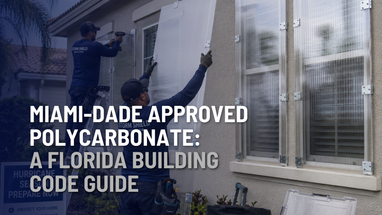
Miami-Dade Approved Polycarbonate: A Florida Building Code Guide to Hurricane-Resistant Storm Panels
Miami-Dade approved polycarbonate hurricane panels are multiwall thermoplastic sheets that have passed Florida's three toughest storm tests — TAS 201, TAS 202, and TAS 203 — and earned a Notice of Acceptance (NOA) from Miami-Dade County's Product Control office. That approval lets the panels be installed legally in Florida's High Velocity Hurricane Zone, where wind speeds can exceed 175 mph. For Florida builders, sign contractors, marine fabricators, and property managers, "Miami-Dade approved" isn't a marketing badge — it's a code requirement.
What Makes Polycarbonate Hurricane-Rated
Polycarbonate is a transparent engineering thermoplastic with one defining property: impact resistance roughly 200 to 250 times that of glass at the same thickness. A flying 2x4 that would shatter a window passes the same test on a 16mm multiwall polycarbonate panel without penetrating the interior surface.
For hurricane applications, the material is usually fabricated as a multiwall (or "structured") sheet — a hollow extruded profile with three to seven internal walls separated by ribs. The multiwall geometry distributes impact energy across the panel, while the air gaps add stiffness without weight. A 16mm five-wall storm panel weighs around 1.4 pounds per square foot, light enough for two-person installation but stiff enough to span a 5-foot opening with proper fastening.
Hurricane-rated polycarbonate is also UV-stabilized on one or both faces, color-stable in salt-laden coastal air, and dimensionally stable through the temperature swings of a Gulf Coast summer. It does not splinter like plywood, corrode like steel, or pit like aluminum after repeated storm cycles.
Florida Building Code & HVHZ: What's Actually Required
Florida regulates hurricane-protection products through the Florida Building Code (FBC), which is updated every three years. The current version — the 2023 FBC — became effective December 31, 2023.
The state is divided into wind-pressure zones based on county and proximity to the coast. Two of those zones matter most for storm panels:
- High Velocity Hurricane Zone (HVHZ): Miami-Dade and Broward counties. Any product that protects a building envelope opening — windows, doors, skylights, vents — must hold a Miami-Dade Notice of Acceptance.
- Windborne Debris Region (WBDR): The rest of Florida's hurricane-exposed counties. Products may be approved either under Miami-Dade NOA or through the Florida Product Approval system referencing ASTM E1886 and ASTM E1996.
Design wind speeds for Risk Category II buildings (most commercial and residential structures) run 175 mph in Miami-Dade and 170 mph in Broward, scaling up for essential facilities. Outside HVHZ, design wind speeds are lower but still demanding — most coastal counties from Pensacola to Jacksonville sit above 140 mph.
The practical takeaway: every storm panel installed in Florida needs documented test data, an approval number, and installation instructions tied to that approval. A polycarbonate sheet without a current NOA or FL number cannot legally cover a code-required opening, no matter how thick or how strong the data sheet looks.
The TAS Testing Sequence: 201, 202, 203
Miami-Dade developed three Testing Application Standards (TAS) in the wake of Hurricane Andrew. Together they form the test sequence every HVHZ-rated storm panel must survive.
TAS 201: Large Missile Impact
A 9-pound 2x4 wood missile, 8 feet long, is fired at the panel from an air cannon at 50 feet per second — roughly 34 mph. The missile must strike at two pre-defined points. The panel passes if the missile does not penetrate the sheet or tear an opening larger than 5 inches by 1/16 inch on the interior face. The full TAS 201-94 protocol is published by ICC Digital Codes.
TAS 202: Uniform Static Air Pressure
The same impacted panel is then loaded with positive and negative static air pressure to simulate wind force. The panel must hold up to design pressure ratings — typically ±70 psf for residential applications, higher for commercial — without separating from its frame, deforming permanently, or letting water through.
TAS 203: Cyclic Wind Pressure Loading
Finally, the panel is hit with roughly 9,000 alternating high-low pressure cycles, simulating the gust-and-recovery rhythm of a major hurricane. A panel that survives TAS 201 and 202 can still fail here through fatigue cracking, fastener loosening, or wall delamination. Only assemblies that pass all three earn a Miami-Dade NOA.
Outside HVHZ, the parallel federal tests are ASTM E1886 (cyclic load) and ASTM E1996 (impact criteria). They cover similar ground at slightly less stringent missile speeds. Most polycarbonate products approved under Miami-Dade NOA are also approved under ASTM, but the reverse is not always true.
Miami-Dade NOA vs. Florida Product Approval
Florida runs two parallel approval systems, and contractors often confuse them.
A Miami-Dade Notice of Acceptance (NOA) is issued by Miami-Dade County's Product Control Section. It carries an NOA number formatted like 22-1108.05 and an expiration date — usually three years after issue. NOAs are mandatory inside HVHZ and accepted statewide.
A Florida Product Approval (FL number) is issued by the Florida Department of Business and Professional Regulation. It carries an FL number formatted like FL12345-R3 and references either the Miami-Dade NOA or independent ASTM test data. FL approvals are accepted outside HVHZ.
Before specifying or installing any polycarbonate storm panel in Florida, verify the approval is current:
An expired NOA voids compliance. Insurance carriers and code inspectors verify approval status during permitting and post-storm claims review.
Multiwall Polycarbonate Storm Panels: Gauges, Walls, and Mounting
The two specifications that drive most polycarbonate storm panel decisions are sheet thickness (gauge) and wall count. The most common HVHZ-approved configuration is a 16mm (5/8") five-wall polycarbonate sheet, typically supplied in standard panel widths around 24 inches and lengths cut to the opening height.
Other configurations include:
- 12mm three-wall: Lighter and lower cost; common for smaller openings and lower-design-pressure applications.
- 16mm five-wall: The workhorse HVHZ panel — passes large-missile TAS 201 with margin and handles direct-mount installation.
- 25mm five-wall or seven-wall: Higher design pressures, larger spans, and commercial storefront applications.
Mounting systems matter as much as the sheet itself. Storm panels are installed using one of three approved methods:
- Direct mount: Panels fasten directly into pre-installed anchors or studs on the wall around the opening. Lowest cost, highest visual impact when stored.
- F-track: A header and sill track captures the panel edges. Faster install, no permanent anchors visible between storms.
- H-track: Used for multi-panel spans on wider openings, with intermediate vertical supports.
Each NOA-approved polycarbonate panel ships with installation instructions specific to its approval. Substituting fasteners, anchors, or track systems outside those instructions voids the approval — a detail that surfaces during insurance inspections after a storm.
Polycarbonate vs. Aluminum vs. Plywood: A Code-Compliance Comparison
Florida property owners and contractors generally choose between three storm panel materials. Here's how they compare for a typical residential window opening:
| Attribute | Polycarbonate (16mm) | Aluminum (.050") | Plywood (5/8") |
|---|---|---|---|
| HVHZ Approved | Yes (with current NOA) | Yes (with current NOA) | Limited (mitigation Class C only) |
| Impact resistance | ~200x glass | High | Moderate, splinters on impact |
| Weight (per sq ft) | ~1.4 lb | ~1.0 lb | ~2.0 lb |
| Light transmission | Translucent (40–60%) | Opaque | Opaque |
| Reusable | Yes, many seasons | Yes, many seasons | Single-use after impact |
| Corrosion in salt air | None | Possible at fasteners | Swells and warps |
| Typical service life | 10–15+ years | 15–20+ years | 1 storm cycle |
Polycarbonate's competitive advantage is the combination of code compliance, light transmission, and reusability. The drawback is up-front cost and surface scratch sensitivity — minor concerns against a 10-plus-year service window.
Choosing the Right Material by Application
Polycarbonate storm panels make the most sense in five common Florida applications:
- Residential windows and sliding doors: Translucency keeps interiors livable during multi-day power outages — a real factor in Category 3+ storms.
- Commercial storefronts: Visibility from the street post-storm helps with security and lets emergency responders see inside.
- Marina and boatyard offices: Salt air corrodes aluminum at fastener points. Polycarbonate stays intact through repeated storm cycles.
- Sign shops and graphics facilities: Same panels can serve as temporary hurricane protection and as a stocked material for client work.
- Industrial buildings with large openings: 25mm panels with H-track systems span wider openings than aluminum at competitive total cost.
For projects where opacity is acceptable and budget is tight, aluminum storm panels remain a defensible choice. For one-storm temporary protection on an unoccupied structure, code-compliant plywood mitigation may pass inspection — but it's a single-use solution.
Frequently Asked Questions
What does "Miami-Dade approved" mean for hurricane panels?
"Miami-Dade approved" means a product holds a current Notice of Acceptance from Miami-Dade County's Product Control Section after passing the TAS 201, TAS 202, and TAS 203 test sequence. The approval is required for installation inside the High Velocity Hurricane Zone (Miami-Dade and Broward counties) and accepted statewide.
What is the difference between TAS 201, TAS 202, and TAS 203?
TAS 201 is the large-missile impact test, where a 9-pound 2x4 is fired at the panel at 50 feet per second. TAS 202 applies uniform static air pressure to test wind-load resistance. TAS 203 cycles roughly 9,000 alternating pressure pulses to test fatigue resistance. A product must pass all three to earn HVHZ approval.
Is polycarbonate stronger than plywood for hurricane protection?
Yes. A 16mm multiwall polycarbonate panel can absorb the same 2x4 missile impact that splits 5/8" plywood, while remaining transparent and reusable across many storm seasons. Plywood is generally considered a single-use mitigation material under Florida's residential mitigation classifications.
What thickness of polycarbonate is required for hurricane panels in Florida?
Most HVHZ-approved polycarbonate storm panels are 16mm five-wall sheets, though 12mm three-wall is approved for smaller openings and 25mm five-wall or seven-wall is used for higher design pressures. Specific thickness requirements depend on the panel's NOA and the opening's design pressure rating — check the installation instructions tied to the approval number.
Are polycarbonate hurricane panels reusable?
Yes. Polycarbonate panels are designed to be installed and removed across multiple hurricane seasons. Service life is typically 10 to 15 years or more with proper storage between storms. Surface scratching from handling is cosmetic and does not affect impact rating.
Do polycarbonate storm panels qualify for insurance discounts?
In most Florida counties, properly permitted and code-compliant storm panels qualify the home for wind mitigation insurance discounts under the OIR-B1-1802 mitigation form. The size of the discount depends on full-perimeter coverage, panel approval status, and other mitigation features. Verify with your insurance carrier and a licensed wind mitigation inspector.
Can polycarbonate hurricane panels be used outside HVHZ counties?
Yes. Outside Miami-Dade and Broward, polycarbonate panels approved under either Miami-Dade NOA or Florida Product Approval (FL number) are valid. Most HVHZ-approved panels carry both approvals, making them usable anywhere in Florida's Windborne Debris Region.
How do I verify a polycarbonate panel's Miami-Dade NOA number?
Use the Miami-Dade Product Control NOA Search. Enter the file number from the panel's documentation. The portal returns the current approval status, expiration date, and downloadable installation instructions. An NOA past its expiration date is not valid for new installations.
Spec Polycarbonate Hurricane Panels for Your Florida Project
Farco Plastics distributes hurricane-rated polycarbonate sheet from major manufacturers, with cut-to-size fabrication available out of our Clearwater, Ft. Lauderdale, Jacksonville, and Orlando warehouses. For projects in the HVHZ, we coordinate with installers and code consultants to make sure the approval number on the data sheet matches the configuration that actually goes on the building.
For technical specifications, current NOA documentation, or cut-to-size quoting on polycarbonate storm panels, request a Farco quote or contact our team.
Related reading from the Farco Resource Center:
- High-Impact-Resistant Plastics in Modern Architecture
- Weather-Resistant Plastics
- Multiwall Plastic Sheets: Materials, Benefits, and Industrial Uses
- Shop Polycarbonate Sheet
- Construction Plastics Applications

About the Author
B Decker is a Digital Content Specialist working with Farco Plastics, with five years of focused content production for the industrial plastics distribution sector and a decade of broader industrial-sector writing experience. B's work covers materials science explainers, fabrication and machining guidance, specification support, and application case studies across thermoplastics, engineering plastics, and composites.
For specification support, sample requests, or material certification documents, contact your local Farco Plastics location.