
Posted by B. Decker on 20th Oct 2026
Fluted Plastic Sheet: Specs, Uses, and How to Choose
By B. Decker, Digital Content Specialist | Farco Plastics | Published: October 20, 2026
Fluted plastic sheet is a lightweight, hollow-core panel, usually extruded from polypropylene. Two flat skins are joined by parallel ribs called flutes, which add stiffness without adding much weight. It is commonly stocked in 3 to 6 mm thicknesses, takes print well, cuts with a utility knife, and is typically rated for −20 °F to 120 °F.
What Is Fluted Plastic Sheet?
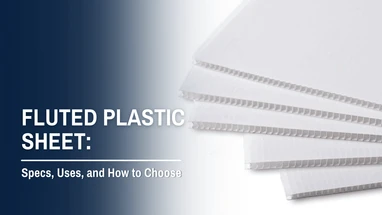
Fluted plastic sheet is a twin-wall, hollow-core panel. Makers extrude polypropylene through a die that forms a top skin, a bottom skin, and the parallel ridges between them. Those ridges are the flutes.
The same product goes by several names: corrugated plastic, corrugated polypropylene, twinwall plastic, and fluted PP. Coroplast® is one maker's brand name for it. Coroplast describes its own sheet as a polyolefin copolymer.
The hollow core is the point. A fluted design weighs less than a solid sheet of similar strength, and a densely fluted design adds thickness and stiffness.
Fluted sheet is the twin-wall member of the multiwall family. If you need glazing, insulation, or light transmission, read our multiwall plastic sheet guide instead. Farco supplies fluted polypropylene sheets for printing and graphics, signage, construction, packaging, and templates.
Fluted Plastic Sheet Specs
Typical specs are below. Values vary by maker, so confirm them on the data sheet for the sheet you buy.
| Spec | Typical value |
|---|---|
| Material | Polypropylene copolymer (polyolefin copolymer) |
| Stocked thickness | 0.118, 0.157, 0.197, 0.236 in (3, 4, 5, 6 mm) |
| Maker's full range | About 2 to 12 mm, thickness tolerance ±5% |
| Typical sheet size | 48 × 96 in |
| Colors | White and custom colors |
| Continuous service temperature | −20 °F to 120 °F |
| Deflection temperature | 80 °C at 1.8 MPa; 100 °C at 0.46 MPa |
| Vicat softening point | 78 °C |
| Flammability | UL 94 HB |
| Surface | Corona treated on both faces, 46 dyne minimum |
| Recyclability | 100% recyclable |
Sources: one distributor's published fluted polypropylene specs and Coroplast's print specifications.
Weight depends on thickness and flute design. Ask your Farco location for the weight of the exact sheet in your quote.
Why Does Flute Direction Matter?
Flute direction affects how you order, square, and fold the sheet.
- Sizing: Makers write the across-flutes dimension first, then the flute length. A 48 × 96 inch sheet is 48 inches across the flutes. State the flute direction when you order.
- Squareness: Edges that run along the flutes are parallel. The cross-flute edges can be up to 3/8 inch out of square. Guide sheets into converting equipment by the parallel edges.
- Creasing: Plastic is more resilient than paperboard. Creasing across the flutes generally needs a wider crease rule than cardboard does.
- Cutting: Twin-wall sheet must be cut completely through. You cannot score it like paperboard.
Can You Print on Fluted Plastic Sheet?
Yes. Both faces get a corona discharge treatment that helps inks and adhesives grip. Coroplast specifies a minimum of 46 dyne on its print grade.
The sheet is nonabsorbent, so a few rules prevent adhesion problems:
- Use the right ink: Choose inks formulated for polyolefin surfaces.
- Keep it clean: Handle sheets as little as possible and store them covered. Dirt and fingerprints cause adhesion problems.
- Warm cold sheets: Let cold sheets reach room temperature before printing. Cold sheets can pick up condensation.
Common print methods include screen printing, digital printing, UV flatbed printing, and vinyl application. Letterpress needs oil-based inks and runs slower than it does on corrugated board. Flexographic printing works with regular rubber plates and may need extra drying. Run a trial before a full job, as makers advise in Coroplast's conversion guide. See our printing and graphics page for more.
How Does Fluted Sheet Perform Indoors and Outdoors?
- Water: The sheet is nonabsorbent. Farco's product page says it stands up to weather, stains, and some chemicals.
- UV: UV-stabilized options exist. Ask whether your sheet is stabilized before you specify it for outdoor use. Makers do not publish a service-life figure, so we do not quote one.
- Temperature: Continuous service runs from −20 °F to 120 °F. Cold also makes cutting and creasing harder.
- Fire: The rating is UL 94 HB. If your project has a fire-rating requirement, check it against that rating first.
Our weather-resistant plastics guide compares longer-life options.
How Does Fluted Plastic Compare With Other Sheet?
Fluted sheet is lighter than a solid sheet of similar strength. Other materials win on clarity, finish, or lifespan.
| If you need | Look at | Why |
|---|---|---|
| Low weight and stiffness for printed or temporary work | Fluted plastic sheet | The hollow core weighs less than solid sheet of similar strength. |
| Light transmission or insulation | Multiwall polycarbonate | See our multiwall guide. |
| A rigid, smooth sign face | PVC foam or ACM | PVC foam suits budget interior and seasonal outdoor work. ACM suits building-mounted signs meant to last about a decade. |
| A solid, chemical-resistant sheet | Solid polypropylene or HDPE | Solid polypropylene is elastic, durable, and chemical resistant. |
Our sign substrates comparison covers the rigid-board options in depth.
What Is the Difference Between Fluted and Solid Polypropylene Sheet?
Both are polypropylene. The difference is the construction, and it changes weight, stiffness, and use.
- Weight: Fluted sheet weighs less than a solid alternative of similar strength.
- Stiffness: A densely fluted design adds thickness and stiffness. Solid sheet is described as extremely elastic and durable.
- Heat: Solid polypropylene does not begin to melt until about 320 °F. Fluted sheet is rated for continuous service up to 120 °F, so the two numbers measure different things.
- Chemicals and light: Solid sheet's chemical resistance makes it a fit for containers. It is also used where light needs to pass through.
- Uses: Fluted sheet is used for food packaging, displays, outdoor signage, boxes, crates, and point-of-purchase displays.
Where Is Fluted Plastic Sheet Used?
- Signs and displays: real estate, election, wayfinding, and construction site signs, plus trade show booths, staging, and point-of-purchase displays.
- Protection: paint barriers, safety partitions, temporary floor and wall protection, and layer pads and dividers.
- Packaging: reusable packaging and containers, plus food and retail packaging.
- Shop and trade work: stencils, countertop templates, and cabinetry templates.
- Storage: agricultural and industrial storage.
How Do You Cut and Convert Fluted Sheet?
- By hand: A standard utility knife works.
- In production: Use a die cutter, a guillotine, or a CNC router. Flatbed die cutting has worked very well. A guillotine can typically cut 10 to 15 sheets at once.
- Creasing: Published crease rules are for 4 mm sheet. Adjust them for other thicknesses.
- Temperature: Convert at room temperature. Cutting and creasing get easier as the sheet warms.
How to Choose Fluted Plastic Sheet
Work through these six questions before you order.
- How stiff must it be? Stocked thicknesses run 3 to 6 mm. Denser flutes and thicker sheet add stiffness.
- What size and flute direction? Write across-flutes first, then flute length.
- What color? White is the common stock color. Custom colors are available by request.
- Will it live outdoors? If yes, ask for a UV-stabilized sheet.
- How will you print it? Confirm the surface treatment and the ink system with your print vendor.
- What happens at end of life? Makers call the sheet 100% recyclable, and it can be reused.
Frequently Asked Questions
Is fluted plastic sheet the same as Coroplast?
Mostly, yes. Coroplast® is one maker's brand name for fluted plastic sheet. The generic names are fluted plastic sheet, corrugated plastic, and twinwall sheet.
How thick is fluted polypropylene sheet?
Common stocked thicknesses are 0.118, 0.157, 0.197, and 0.236 inch (3 to 6 mm). A maker's full range runs about 2 to 12 mm, with a ±5% thickness tolerance.
Is fluted plastic sheet waterproof and UV resistant?
It resists water, and UV-stabilized options are available. Ask which one you are getting. Makers do not publish a service life for outdoor use.
Can you print on fluted plastic sheet?
Yes. Both faces are corona treated, and one maker specifies a 46 dyne minimum. Use polyolefin-compatible inks and keep the surface clean. Screen, digital, and UV flatbed printing all work.
How do you cut fluted plastic sheet?
Cut it with a utility knife, a die cutter, or a CNC router. The blade must go completely through both skins. A guillotine can cut 10 to 15 sheets at a time.
What temperature can fluted plastic sheet handle?
One distributor lists −20 °F to 120 °F for continuous service. The deflection temperature is 80 °C at 1.8 MPa. Cold sheet is harder to cut and crease.
Is fluted plastic sheet recyclable?
Makers call it 100% recyclable. Check with your local recycler that it accepts polypropylene.
What is the difference between fluted plastic and multiwall polycarbonate?
Multiwall polycarbonate is chosen for light transmission and insulation. Fluted polypropylene is chosen for lightweight, printable, cut-to-shape work such as signs, protection, and packaging.
The Bottom Line
Fluted plastic sheet is the light, printable, easy-to-cut option for signs, protection, templates, and packaging. Pick the thickness for stiffness, state the flute direction, and ask for UV stabilization if it goes outside.
Farco Plastics has supplied plastics since 1978 from six locations. Data sheets and samples are available on request.
This article is for informational purposes only. Material choice, thickness, and code compliance must follow your project specifications, the manufacturer's data sheet, and advice from a qualified professional. Values shown are typical and vary by maker.

About the author
B. Decker is a Digital Content Specialist at Farco Plastics. B brings five years of industrial plastics distribution content experience and about ten years of broader industrial writing, covering materials explainers, fabrication guidance, and specification support. Content is reviewed by applications engineering and product management.